
Building a Guitar Practice Routine

Mastering the guitar is a rewarding yet challenging journey that requires dedication, consistency, and a well-structured practice routine. Whether you're a beginner strumming your first chords or an intermediate player aiming to refine your technique, establishing good habits in your practice routine is essential for steady progress. A thoughtful routine not only builds technical proficiency but also fosters creativity, musicality, and a deeper connection with the instrument. In this article, we’ll explore the key components of an effective guitar practice routine and highlight the good habits that will help you develop your skills efficiently.
The Importance of a Structured Practice Routine
A guitar practice routine is more than just picking up the instrument and playing for a set amount of time. It’s a deliberate, focused effort to improve specific aspects of your playing while maintaining motivation and avoiding burnout. Without structure, practice can become aimless, leading to frustration or plateaus in progress. A well-designed routine helps you:
Target Weaknesses: Identify and address areas where you struggle, such as speed, accuracy, or chord transitions.
Build Muscle Memory: Reinforce techniques through repetition, making complex movements feel natural over time.
Stay Consistent: Create a sustainable habit that fits your schedule, ensuring regular practice.
Measure Progress: Set clear goals and track improvement, which boosts confidence and motivation.
To achieve these benefits, your routine should incorporate a variety of exercises, balance technical and creative practice, and be tailored to your skill level and goals. Below, we outline the key components of an effective routine and the habits that will help you succeed.
Components of an Effective Guitar Practice Routine
A balanced guitar practice routine typically includes warm-ups, technical exercises, music theory, repertoire development, and creative exploration. Here’s a breakdown of each component and how to approach them:
1. Warm-Up (5-10 Minutes)
Warming up prepares your fingers, wrists, and mind for practice. It reduces the risk of strain and helps you focus.
Good Habit: Start with Simple Exercises
Begin with basic finger exercises, such as the "1-2-3-4" chromatic exercise (playing frets 1, 2, 3, and 4 on each string with each finger). Use a metronome to maintain a steady tempo and gradually increase speed. Alternate picking or fingerpicking patterns can also warm up your picking hand. Keep the tempo slow to prioritize accuracy over speed.
Good Habit: Stay Mindful
Focus on your posture, hand positioning, and breathing. Avoid tension in your shoulders or wrists, as this can lead to discomfort or injury. A mindful warm-up sets the tone for a productive session.
2. Technical Exercises (15-20 Minutes)
Technical exercises build the foundation for clean, precise playing. These drills improve dexterity, coordination, and speed.
Good Habit: Focus on Specific Techniques
Dedicate time to techniques relevant to your goals, such as alternate picking, hammer-ons, pull-offs, bends, or slides. For example, practice a major scale across all six strings to improve fretboard navigation, or work on barre chords to strengthen your fretting hand. Use a metronome to track progress and ensure evenness in your playing.
Good Habit: Break Down Complex Skills
If you’re struggling with a technique, break it into smaller parts. For instance, if a fast solo feels overwhelming, practice one phrase at a time, gradually increasing the tempo. This habit of incremental learning prevents frustration and builds confidence.
3. Music Theory and Ear Training (10-15 Minutes)
Understanding music theory and developing your ear enhances your ability to improvise, compose, and play by ear.
Good Habit: Learn Scales and Chords
Spend time memorizing major and minor scales, pentatonic scales, and common chord progressions (e.g., I-IV-V or ii-V-I). Practice applying them in different keys to build versatility. For example, learn the C major scale and use it to improvise simple melodies over a backing track.
Good Habit: Train Your Ear
Practice identifying intervals, chords, or melodies by ear. Use apps or online tools to test your ability to recognize notes or replicate melodies on the guitar. This habit strengthens your musical intuition and reduces reliance on tablature.
4. Repertoire Development (15-20 Minutes)

Learning songs or pieces is a practical way to apply your skills and stay motivated. Choose pieces that challenge you but are within reach.
Good Habit: Select Diverse Pieces
Pick songs from different genres or styles to broaden your skills. For example, a beginner might learn simple folk songs with open chords, while an intermediate player could tackle a blues solo or a classical piece. Break songs into sections (verse, chorus, bridge) and practice them slowly before combining them.
Good Habit: Polish Your Performance
Once you can play a song, focus on dynamics, phrasing, and expression. Record yourself to identify areas for improvement, such as timing or tone. This habit ensures you’re not just playing notes but creating music.
5. Creative Exploration (10-15 Minutes)
Creativity keeps practice engaging and helps you develop your unique voice as a guitarist.
Good Habit: Improvise Regularly
Set aside time to jam over backing tracks or create your own chord progressions. Experiment with different scales, rhythms, or effects to discover new sounds. This habit fosters spontaneity and confidence in your playing.
Good Habit: Write Your Own Music
Try composing a short melody, riff, or chord progression. Even simple ideas can spark creativity and reinforce your understanding of music theory. Keep a notebook or recording device handy to capture ideas.
Good Habits for Long-Term Success
Beyond the components of your practice routine, cultivating the following habits will maximize your progress and enjoyment:
Set Clear, Achievable Goals
Define specific goals for each practice session and your overall journey. For example, a short-term goal might be “learn the A minor pentatonic scale in one position,” while a long-term goal could be “play a 3-minute solo fluently.” Write down your goals and review them regularly to stay focused.
Practice Consistently
Consistency is more important than duration. Aim for 30-60 minutes of focused practice daily, but even 15 minutes is valuable if you’re busy. Schedule practice at a time when you’re alert and free from distractions, such as early morning or after dinner.
Use a Metronome and Timer
A metronome ensures you develop speed without sacrificing accuracy, while a timer keeps your practice session structured. For example, allocate 5 minutes to warm-ups, 10 minutes to scales, and so on. This habit prevents you from spending too much time on one area.
Track Your Progress
Keep a practice journal to log what you worked on, challenges you faced, and milestones achieved. Reviewing your journal can reveal patterns (e.g., consistent struggles with barre chords) and help you adjust your routine. Recording your playing periodically also provides a clear measure of improvement.
Stay Patient and Positive
Progress on the guitar can be slow, and plateaus are normal. Celebrate small victories, like nailing a tricky chord transition, and avoid comparing yourself to others. A positive mindset keeps you motivated and resilient.
Take Care of Your Body
Playing guitar is physically demanding, so maintain proper posture and hand positioning to avoid strain. Take short breaks during practice to stretch your fingers and wrists. Stay hydrated and consider hand-strengthening exercises off the guitar, like squeezing a stress ball.
Seek Feedback and Inspiration
Share your progress with a teacher, friend, or online community to gain constructive feedback. Watching performances or tutorials by skilled guitarists can also inspire new ideas and techniques. Platforms like YouTube or forums like Reddit’s r/guitar are great for connecting with other players.
Sample Practice Routine (30-45 Minutes)
Here’s an example of a beginner-friendly routine to illustrate how these components and habits come together:
Warm-Up (5 min): Play the 1-2-3-4 exercise on the first four frets, focusing on clean notes and relaxed hands.
Technical Exercises (10 min): Practice switching between G, C, and D chords, aiming for smooth transitions. Use a metronome at 60 BPM to strum each chord four times.
Music Theory (5 min): Memorize the notes on the low E string (E, F, F#, G, etc.) and quiz yourself.
Repertoire (15 min): Work on a simple song like “Wonderwall” by Oasis, focusing on the verse chord progression (Em, G, D, Am).
Creative Exploration (5-10 min): Improvise a melody using the open strings or create a simple strumming pattern.
For intermediate or advanced players, adjust the routine to include more complex techniques (e.g., sweep picking, hybrid picking) and longer sessions.
Conclusion
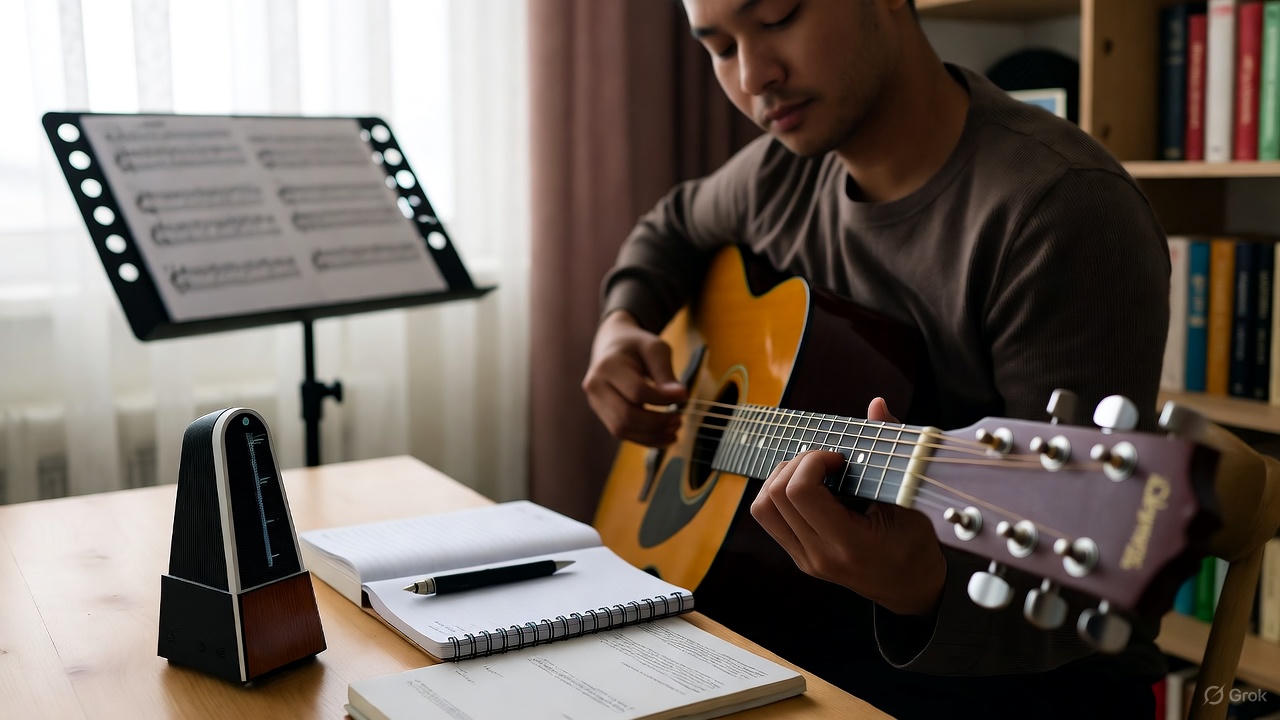
Building a guitar practice routine is about creating a framework that balances discipline with creativity. By incorporating warm-ups, technical exercises, music theory, repertoire, and improvisation, and by cultivating habits like consistency, goal-setting, and patience, you’ll develop the skills needed to become a confident, expressive guitarist. The key is to practice intentionally, stay curious, and enjoy the process. With time and dedication, your routine will transform your playing and deepen your love for the guitar.